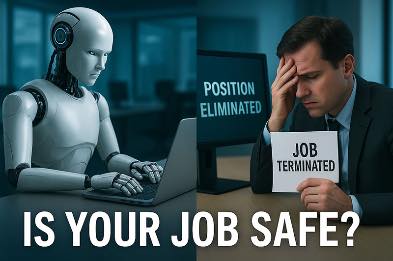
Imagine waking up one morning to find that your job no longer exists. Not because you did anything wrong, but because a machine learned to do it better, faster, and for free.
This might sound like a scene from a science fiction movie. But according to the World Economic Forum’s Future of Jobs Report 2025, this is the reality we are heading toward. The report warns that 39% of core job skills will become outdated by 2030 . That means nearly four out of every ten things you rely on to do your job today may soon become irrelevant.
But here is the good news: while 92 million old jobs may disappear, 170 million new jobs are expected to be created by 2030 . That is a net gain of 78 million jobs globally. The challenge is that these new jobs require completely different skills.
This article will help you understand which jobs are at risk of vanishing and, more importantly, what you should learn today to secure your future.
Why Are Jobs Disappearing?
Three major forces are reshaping the job market:
- Artificial Intelligence (AI) and Automation: AI is no longer a futuristic concept. It is here, and it is getting smarter every day. AI can now write articles, design graphics, answer customer calls, and even drive trucks . Jobs that involve repetitive tasks, whether physical or mental, are the most at risk .
- Digitalization: We are moving toward a paperless, cashless world. Banks are going branchless, stores are going cashierless, and postal services are declining as we switch to email and e-bills .
- Self-Service Technology: From self-checkout kiosks at supermarkets to online flight booking apps, companies are replacing human workers with technology that customers can use themselves .
Let us look at the specific jobs that experts predict will decline sharply or even disappear by 2030.
The Jobs Most at Risk of Disappearing
Based on data from the World Economic Forum, McKinsey, and other research organizations, here are the roles facing the biggest threats .
1. Data Entry Clerks
This is perhaps the most vulnerable job of all. AI text recognition and workflow automation tools can now process documents, scan information, and organize data in seconds with near-perfect accuracy . According to the WEF, data entry is among the fastest-declining roles globally .
- Why it’s disappearing: Machines are simply faster and make fewer mistakes.
- Projected decline: Data entry clerk roles are expected to decline by 34% by 2030 .
2. Bank Tellers and Related Clerks
Remember when you had to visit a bank branch to deposit a check or withdraw money? Today, you can do it all from your phone. ATMs, digital KYC, and AI-driven customer service have automated most routine banking tasks . McKinsey estimates that over 40% of routine banking operations will be automated by 2030 .
- Why it’s disappearing: Digital banking apps are more convenient for customers.
- Projected decline: Bank teller roles are expected to decline by 35% .
3. Cashiers and Ticket Clerks
Self-checkout systems, mobile payment apps, and “scan-and-go” stores are becoming the norm. Retail giants around the world are shifting to automated billing, which cuts out the need for human cashiers .
- Why it’s disappearing: Stores want to reduce labor costs and speed up checkout.
- Projected decline: Cashier roles are expected to decline by 30% .
4. Postal Service Clerks
With the world shifting to email, e-bills, and paperless communication, the volume of traditional mail has dropped dramatically. Postal services in many countries have reported declines in letter volume of 20–40% over the past decade . Even package delivery is becoming automated with drones and robots .
- Why it’s disappearing: Digital communication is replacing physical mail.
- Projected decline: This is the fastest-shrinking job, with a projected decline of 40% .
5. Telemarketers
AI voice agents and chatbots can now make thousands of calls simultaneously. They never get tired, never get rejected emotionally, and cost almost nothing to run .
- Why it’s disappearing: AI can handle cold calling more efficiently.
- Projected decline: Telemarketing jobs are expected to shrink by 16% .
6. Travel Agents (Traditional)
Why would you pay a travel agent when you can book flights, hotels, and entire itineraries online in minutes? Apps and websites have made the traditional travel agency model almost obsolete .
- Why it’s disappearing: Online platforms offer more choices and better prices instantly.
7. Administrative Assistants and Executive Secretaries
AI-powered scheduling bots, document automation tools, and virtual assistants are redefining office support. Tasks like scheduling meetings, managing emails, and organizing files can now be done by software .
- Why it’s disappearing: Automation tools are cheaper and faster.
- Projected decline: These roles are expected to decline by 28% .
8. Printing and Related Trades Workers
As newspapers and magazines move online, the demand for print has collapsed. Publishing houses are downsizing, and digital publishing is taking over .
- Why it’s disappearing: The world is consuming content on screens, not paper.
- Projected decline: These roles are expected to decline by 26% .
9. Accounting and Bookkeeping Clerks
Software like QuickBooks and various AI tools can now handle payroll, tax calculations, and financial records with minimal human input .
- Why it’s disappearing: Accounting software is accurate and always updated with the latest tax laws.
- Projected decline: These roles are expected to decline by 24% .
10. Graphic Designers (Entry-Level)
This might come as a surprise, but entry-level graphic design is on the list. With the rise of AI image generators (like Midjourney and DALL-E) and easy-to-use tools like Canva, many basic design tasks (creating social media posts, simple logos, etc.) can now be done by non-designers .
- Why it’s disappearing: AI can generate hundreds of design options in seconds.
- Projected decline: Graphic designer roles are expected to decline by 20% .
What to Learn Instead: The Skills and Jobs of the Future
So, if these jobs are going away, what should you learn? The key is to focus on skills that machines cannot easily replicate. These are skills that require human judgment, creativity, emotional intelligence, and complex problem-solving .
Here are the careers that are booming and the skills you need to get them.
1. AI and Machine Learning Specialists
This is the number one growing job in the world. Companies need people who can build, train, and maintain AI systems . This includes specialized roles in ethical AI deployment and bias mitigation .
- What to learn: Programming (Python, R), data structures, algorithms, and machine learning frameworks.
- Why it’s future-proof: You are the one building the machines, so you will always be in demand.
2. Data Scientists and Big Data Analysts
Every company today is drowning in data, but data alone is useless. Companies need experts who can “wrangle, interpret, and act on it” to translate bytes into business insights . These professionals help businesses make smart decisions.
- What to learn: Statistics, data visualization (tools like Power BI or Tableau), and database querying (SQL) .
- Why it’s future-proof: Data is the new oil, and data scientists are the refiners.
3. Cybersecurity Analysts
As the world goes digital, the risk of cyberattacks grows. Hackers target banks, hospitals, and governments. Cybersecurity experts are the defenders who protect sensitive data and critical infrastructure .
- What to learn: Network security, ethical hacking, risk management, and security protocols.
- Why it’s future-proof: As long as there are hackers, there will be a need for people to stop them.
4. Renewable Energy Technicians and Sustainability Experts
The world is pivoting toward green energy to fight climate change. This creates massive demand for people who can install solar panels, maintain wind turbines, and work on grid integration . Companies also need consultants to guide them on environmental compliance (ESG) .
- What to learn: Electrical engineering, solar/photovoltaic technology, wind turbine technology, and environmental science.
- Why it’s future-proof: The planet needs saving, and governments are investing heavily in this sector .
5. Healthcare and Care Roles
No algorithm can comfort a scared patient or bathe an elderly person with dignity and respect. Roles like nurses, social workers, therapists, and personal care aides are expanding rapidly . The aging population in many countries means this demand will only grow .
- What to learn: Nursing, geriatric care, physical therapy, counseling, and social work.
- Why it’s future-proof: These jobs require human empathy and touch, which AI cannot provide.
6. Skilled Trades (Construction, Electricians, Plumbers)
While office jobs are being automated, hands-on jobs are thriving. AI cannot lay bricks, fix a leaking pipe, or rewire a house . There is a massive shortage of skilled tradespeople in many countries .
- What to learn: Carpentry, electrical work, plumbing, masonry, and HVAC installation.
- Why it’s future-proof: These are physical jobs that require problem-solving in unique, real-world environments.
The Skills You Must Develop
Beyond specific job titles, you need to build certain core skills that will help you adapt to any change. According to the World Economic Forum, these are the top skills for 2030 :
- Analytical Thinking: The ability to look at information, understand context, and make smart decisions .
- Resilience, Flexibility, and Agility: The willingness to learn new things and adapt to change .
- Creative Thinking: Machines can follow rules, but humans need to think of new ideas .
- Leadership and Social Influence: The ability to inspire and lead teams .
- Technological Literacy: Understanding how technology works, even if you are not a programmer .
- Curiosity and Lifelong Learning: The most important skill of all is the ability to keep learning throughout your life .
Conclusion: Don’t Fear the Robot, Adapt to It
The job market of 2030 will look very different from today. Yes, many routine jobs will disappear. But for every job that vanishes, new and exciting opportunities are being created.
The key is not to fear technology but to learn how to work with it. Think of AI as a tool that can make you faster and better, not just a replacement for your job .
If you are currently in a job that is on the “at-risk” list, do not panic. Start learning today. Take an online course in data analysis. Learn how to use AI tools in your current field. Develop your soft skills.
The future belongs not to those who wait, but to those who prepare. Start preparing today.
Disclaimer: This article is based on reports from the World Economic Forum, McKinsey, and other labor market research organizations . Job market trends can vary by country and industry. This information is for educational and guidance purposes only.
Leave a Reply